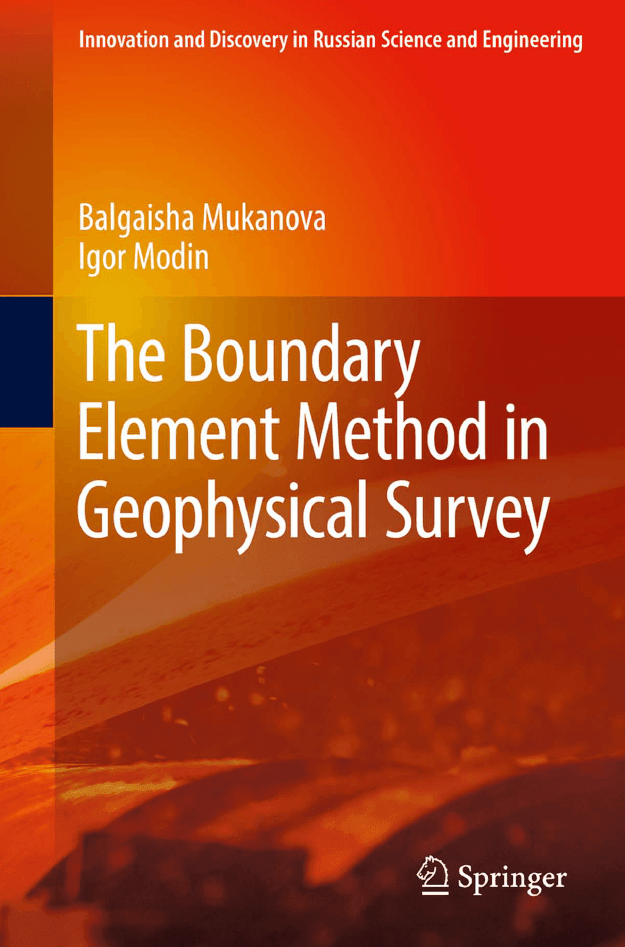
The Boundary Element Method in Geophysical Survey
29 May 2018 Off By The Engineering CommunityThe Boundary Element Method in Geophysical Survey — Balgaisha Mukanova & Igor Modin
The Boundary Element Method in Geophysical Survey by Balgaisha Mukanova and Igor Modin is a specialized scientific reference published by Springer that focuses on advanced numerical modelling techniques in geophysics, with a particular emphasis on the Boundary Element Method (BEM) and the Integral Equations Method (IEM). The book is aimed at researchers, postgraduate students, and engineers who work on computational geophysics and need rigorous approaches for modelling subsurface investigations.
A major strength of this monograph is its clear positioning of BEM as an efficient numerical strategy for geophysical problems involving direct current (DC) sounding and interpretation of geological media. The authors present theoretical foundations and then connect them to practical modelling needs, including the numerical solution of integral equation systems and techniques such as adaptive mesh generation, which are essential when dealing with complex subsurface geometry.
The publication is particularly relevant for professionals working in electrical resistivity tomography (ERT) and related resistivity methods, where realistic subsurface models often involve discontinuities, piecewise conductivity structures, and irregular interfaces. By addressing these complexities in a structured way, the book supports engineers who want to move beyond simplified assumptions and develop more reliable modelling procedures for interpretation and inversion-related tasks.
Overall, The Boundary Element Method in Geophysical Survey is a strong technical reference for readers seeking an advanced and academically rigorous approach to geophysical numerical modelling, especially in DC-based resistivity surveying where BEM-based formulations offer computational efficiency and strong theoretical consistency.
Legal Links to Buy / Access the Book
You can access or obtain the book legally through these official sources:
-
SpringerLink (Official book page)
-
Springer (Official PDF / eBook access, depending on your institution or purchase)
-
Google Play Books (Legal eBook purchase)
-
Open Library (catalog listing / library access options)