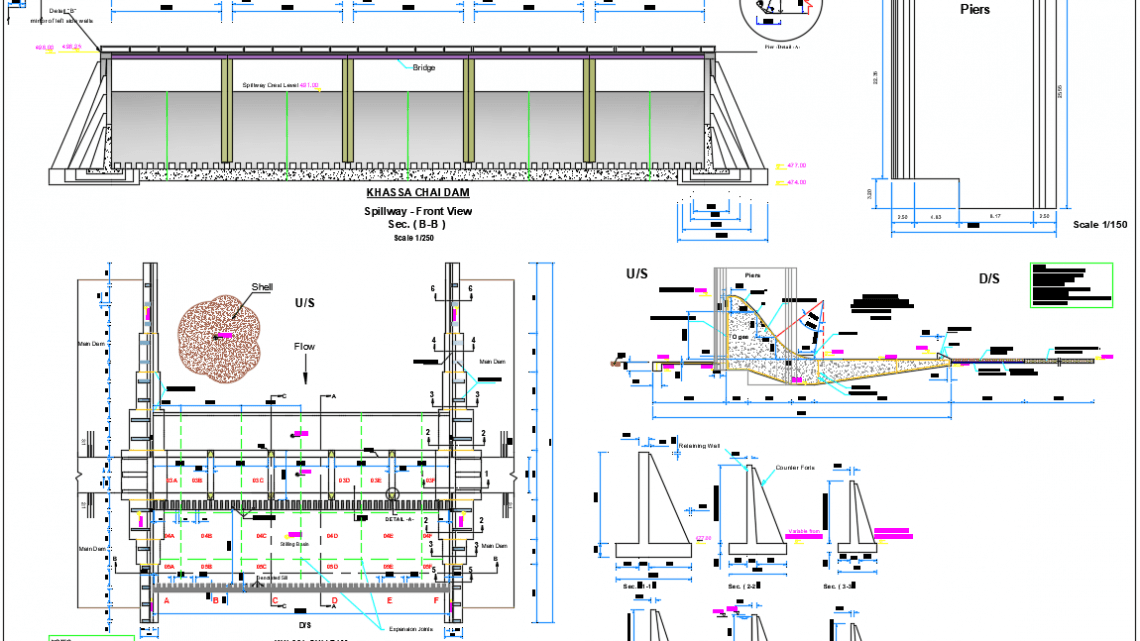
Spillway General Shattering Free Drawing
30 July 2025Table of Contents
Spillway General Shattering Free Drawing
What is Spillway General Shattering?
Spillway general shattering is not a single, instantaneous event, but rather the culmination of various erosional forces and structural weaknesses that lead to the large-scale failure of a spillway. It involves the widespread breakup and disintegration of the spillway’s concrete lining, often resulting in massive holes, displaced concrete slabs, and a complete loss of functionality. This failure prevents the safe release of excess water from a reservoir, potentially leading to the overtopping of the dam itself—a scenario with catastrophic consequences for downstream communities.
The Primary Culprits: Unpacking the Causes of Spillway Failure
A spillway’s integrity is constantly challenged by the incredible force of moving water. Several key factors can contribute to its eventual shattering:
1. Cavitation: The Insidious Power of Imploding Bubbles
One of the most insidious and powerful culprits in spillway damage is cavitation. This phenomenon occurs when high-velocity water flows over irregularities or offsets in the spillway’s surface. The rapid flow causes a pressure drop, leading to the formation of water vapor bubbles. As these bubbles move downstream into areas of higher pressure, they collapse, or “implode,” with incredible force. This implosion creates a micro-jet of water that can strike the concrete surface with pressures high enough to chip away at it over time, creating a “pitting” effect that can grow into massive voids.
2. Stagnation Pressure: The Force of Water as a Hydraulic Wedge
When cracks, joints, or initial cavitation damage exist, water flowing at high speeds can be forced into these openings. As this water abruptly stops, its kinetic energy is converted into intense pressure—a phenomenon known as stagnation pressure. This pressure can act as a powerful hydraulic wedge, exerting an upward force on the concrete slabs. If the slab is not sufficiently anchored or if the underlying drainage is inadequate, this uplift pressure can lift and shatter the concrete from below.
3. Underlying Structural and Geological Flaws
The initial design and construction of the spillway are paramount to its long-term survival. Common flaws that contribute to failure include:
-
Inadequate Foundation: Building a spillway on poor-quality, erodible rock without proper treatment can lead to undermining of the structure.
-
Poor Drainage: If water seeps beneath the concrete slabs and cannot drain away, it creates uplift pressure that destabilizes the structure.
-
Construction Defects: The use of low-strength concrete, poorly designed joints between slabs, or insufficient steel reinforcement can create inherent weak points that are susceptible to failure under stress.
4. Abrasion and Debris Impact
Over time, the constant flow of water carrying sediment, gravel, and sand acts like sandpaper, wearing away the concrete surface through abrasion.
To download more free Autocad templates please visit www.cadtemplates.org