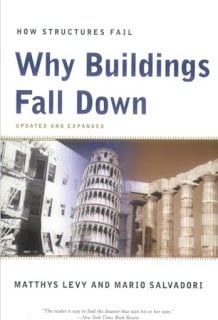
Why buildings fall down how structures fail
7 December 2017Table of Contents
Why Buildings Fall Down: How Structures Fail by Matthys Levy & Mario Salvadori
Some engineering books teach you how to design structures when everything goes right. But the books that truly make you a better engineer are the ones that explain what happens when things go wrong—because failure teaches clarity, discipline, and real structural understanding.
That’s exactly why Why Buildings Fall Down: How Structures Fail by Matthys Levy and Mario Salvadori is considered a classic. It’s not a heavy calculation-based textbook—it’s a clear, engaging, and highly educational book that explains structural failures in a way that engineers, architects, and even non-technical readers can understand.
It turns complex engineering ideas into simple explanations, using real failure examples and structural logic to answer the most important question:
Why do buildings collapse?
Quick Overview
Title: Why Buildings Fall Down: How Structures Fail
Authors: Matthys Levy & Mario Salvadori
Category: Structural failure, structural behavior, engineering learning
Best for: Engineering students, architects, structural engineers, construction professionals, curious readers
Style: Easy-to-read, concept-driven, failure-focused learning
What This Book Covers
Instead of focusing on advanced formulas, the book teaches the principles of structural behavior through failure. It typically explores:
-
How loads travel through structures
-
Why structural form matters
-
Common failure modes, such as:
-
overload and insufficient strength
-
buckling instability
-
foundation settlement and soil failure
-
poor design assumptions
-
construction errors
-
material weakness or deterioration
-
-
Historical failures and famous collapses
-
How good engineering prevents collapse
-
redundancy
-
safety factors
-
detailing discipline
-
inspection and maintenance awareness
-
The result is a book that teaches you to “think structurally”—which is one of the most valuable skills in engineering.
What I Liked Most (Strengths)
1) Very clear explanations (even for beginners)
This is one of the best books for learning structural intuition. It breaks down difficult topics like:
-
buckling vs crushing
-
bending vs shear failure
-
stability vs strength
-
progressive collapse concepts
And it does it without overwhelming readers with equations.
2) Great for engineers AND architects
Architects often ask why certain structural rules exist. Engineers often struggle to explain them without heavy calculations.
This book becomes the perfect bridge—it helps both disciplines speak the same language of structure, safety, and form.
3) Strong “engineering mindset” lessons
The book teaches a deeper professional lesson:
Structures don’t fail by accident—failure has causes.
And those causes can often be prevented by better thinking, checking, and detailing.
What Could Be Better (Limitations)
1) Not a design-code or calculation manual
If your goal is to design beams, columns, slabs, or connections with full numerical checks, this book won’t replace engineering design textbooks. It’s more about understanding failure logic than providing detailed calculations.
2) Some readers may want more modern case studies
Depending on the edition, the examples may focus on older well-known failures. The lessons are timeless—but readers looking for more recent disasters may need additional sources.
Who Should Read Why Buildings Fall Down?
Highly recommended for:
-
civil and structural engineering students
-
architecture students who want stronger structural understanding
-
graduate engineers building design intuition
-
site engineers and construction professionals
-
anyone interested in how structures fail and how safety is achieved
Less ideal for:
-
engineers who only want code-based design examples and calculations
-
readers looking for advanced structural dynamics or FEM procedures
Final Verdict
Why Buildings Fall Down is one of the best introductory books on structural failure ever written. It teaches the principles of structural behavior through real collapse logic, helping readers understand that structural safety is not just mathematics—it is judgment, form, load path awareness, and discipline.