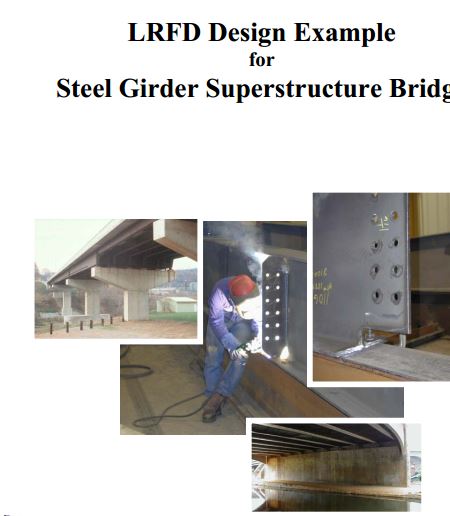
LRFD Design Example for Steel Girder Supertructure Bridge
27 September 2020LRFD Design Example for Steel Girder Superstructure Bridge
For engineers and civil engineering students working in bridge design, LRFD Design Example for Steel Girder Superstructure Bridge is a practical resource that focuses on one of the most common bridge systems used worldwide: the steel girder superstructure. Built around the LRFD methodology (Load and Resistance Factor Design), the document provides a structured example of how bridge components can be designed and verified using modern limit-state principles.
What makes this guide particularly useful is its direct approach. Instead of presenting LRFD rules in an abstract way, it walks the reader through a real design workflow. This helps bridge designers better understand how loads are evaluated, how governing combinations are selected, and how structural checks are carried out to ensure safety, serviceability, and long-term performance.
From an educational perspective, it is a valuable reference for anyone aiming to connect theoretical LRFD concepts with engineering practice. It supports learning by illustrating how calculations are organized and how design decisions are justified in a professional context. For junior engineers, it can serve as a strong introduction to bridge superstructure design, while more experienced designers may find it useful as a quick refresher or benchmarking tool.
Overall, LRFD Design Example for Steel Girder Superstructure Bridge is a straightforward and engineering-focused design example. It stands out as a helpful document for readers who want a clearer understanding of LRFD bridge design procedures, especially when working with steel girder bridge superstructures.