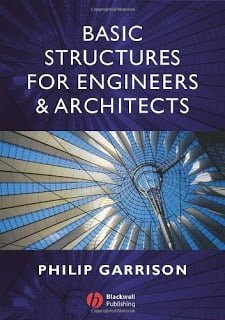
Basic Structures for Engineers & Architects by Philip Garrison
20 November 2017Table of Contents
Basic Structures for Engineers & Architects by Philip Garrison
Many structural books are written only for engineers—full of equations, code clauses, and detailed derivations. But in real projects, the best outcomes happen when engineers and architects share the same structural language: load paths, structural form, stability, and how a building “stands up” in a clean, buildable way.
That’s exactly where Basic Structures for Engineers & Architects by Philip Garrison stands out. It’s a clear, concept-driven book that explains structural behavior in a way that helps engineers strengthen fundamentals and helps architects understand structure as part of design, not as an afterthought.
Quick Overview
Title: Basic Structures for Engineers & Architects
Author: Philip Garrison
Field: Structural fundamentals + structural form and behavior
Best for: Architecture students, civil/structural engineering students, early-career designers, multidisciplinary teams
Use cases: Understanding load paths, selecting structural systems, conceptual design, building design coordination
What This Book Covers
This book focuses on the “core language” of structures: how forces travel, how structural systems resist them, and why certain forms are efficient. It typically explains:
-
Structural principles
-
loads, reactions, equilibrium
-
tension vs compression
-
bending and shear basics
-
-
Load paths and structural behavior
-
how buildings transfer load to the ground
-
structural stability and lateral resistance
-
-
Common structural systems
-
beams, slabs, frames
-
trusses and arches
-
shells and space structures (conceptually)
-
-
Conceptual sizing and efficiency
-
why spans matter
-
how depth, stiffness, and material choice affect performance
-
-
Structural form + architectural design integration
-
selecting systems that match design intent
-
early-stage coordination thinking
-
The emphasis is not “design code calculations,” but structural understanding, which is often what architects need—and what engineers benefit from revisiting.
What I Liked Most (Strengths)
1) Very strong conceptual clarity
This is one of the best types of books to develop intuition. If you can see load paths clearly, you make better decisions early—before expensive design changes.
2) Great bridge between engineering and architecture
It helps architects understand what engineers mean by:
-
stability
-
lateral systems
-
stiffness vs strength
-
load transfer
-
efficiency of structural form
And it helps engineers communicate structural reasoning in a more visual and design-friendly way.
✅ 3) Ideal for early-stage design thinking
If you work on concept design, feasibility studies, or early structural schemes, this kind of book is powerful because it supports better “first choices” for structural form and system selection.
What Could Be Better (Limitations)
1) Not a detailed calculation/design-code manual
If your goal is to perform complete reinforced concrete or steel design to a national code, this is not that kind of book. It is meant for fundamentals, understanding, and conceptual design support.
2) Advanced engineers may find parts too introductory
If you already design complex structures daily, the content might feel basic—though it can still be useful as a refresher or as a teaching tool for junior team members.
Who Should Read This Book?
Highly recommended for:
-
architecture students learning how structures work
-
structural engineering students strengthening fundamentals
-
designers who want better intuition about structural form
-
multidisciplinary teams who need a shared language
-
engineers who want a good “teaching” reference for juniors
Less essential for:
-
specialists seeking advanced analysis methods or code design procedures
-
engineers who only want detailed worked examples and formulas
Final Verdict
Basic Structures for Engineers & Architects by Philip Garrison is a clear, concept-driven book that builds the structural intuition needed for good building design. Its biggest value is how it explains structure in a way that supports both engineers and architects—helping teams make better structural decisions earlier, with fewer surprises later.