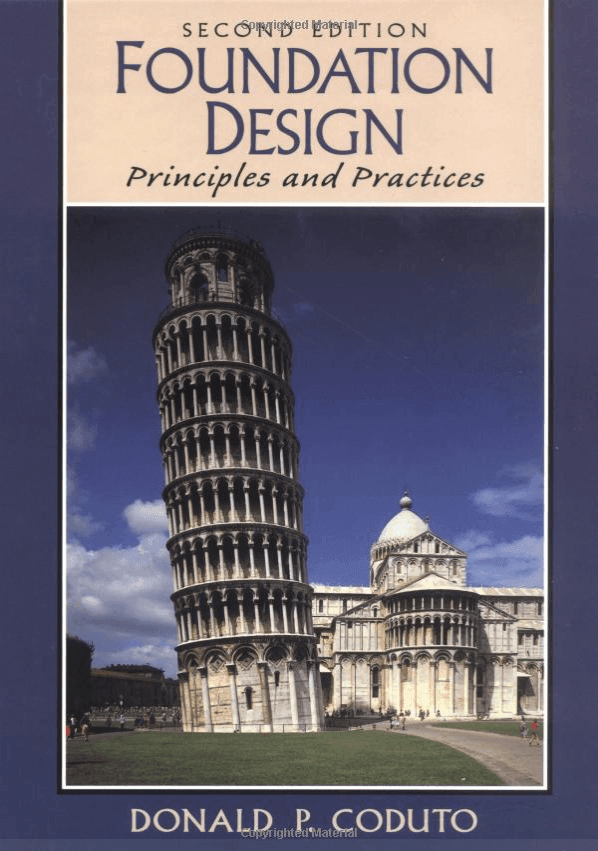
Foundation Design: Principles and Practices (2nd Edition)
28 December 2017Table of Contents
Foundation Design: Principles and Practices – A Complete Guide for Civil Engineers
Foundation Design: Principles and Practices is a well-known reference in geotechnical and structural engineering, widely used by civil engineers, students, and researchers involved in foundation analysis and design. The book focuses on the engineering principles behind safe and efficient foundation systems, supported by practical design approaches and real-world examples.
This article explains what the book covers, who it is for, and why it remains relevant for modern foundation engineering practice.
What Is “Foundation Design: Principles and Practices” About?
The book provides a structured explanation of how foundations transfer loads from structures to the ground while ensuring stability, safety, and serviceability. It bridges the gap between geotechnical theory and practical foundation design.
Rather than relying on formulas alone, it emphasizes:
-
Engineering judgment
-
Soil–structure interaction
-
Construction considerations
-
Performance-based design concepts
Key Topics Covered in the Book
1. Fundamentals of Soil Mechanics for Foundation Design
The book revisits essential soil mechanics concepts directly related to foundation behavior, including:
-
Stress distribution in soils
-
Shear strength and compressibility
-
Bearing capacity principles
These fundamentals are explained in the context of design decision-making, not just theory.
2. Shallow Foundation Design
A significant portion of the book focuses on:
-
Spread footings
-
Strip footings
-
Mat and raft foundations
Design considerations include:
-
Bearing capacity failure
-
Settlement analysis
-
Effect of groundwater
-
Load eccentricity
3. Deep Foundations
The book also addresses deep foundation systems such as:
-
Piles
-
Drilled shafts
-
Caissons
It explains:
-
Load transfer mechanisms
-
Skin friction and end bearing
-
Group effects
-
Installation and construction impacts
4. Settlement and Serviceability
Beyond ultimate capacity, the book places strong emphasis on:
-
Immediate settlement
-
Consolidation settlement
-
Differential settlement
This focus reflects real engineering practice, where serviceability often governs foundation design.
5. Foundation Design in Problematic Soils
Special ground conditions are discussed, including:
-
Soft clays
-
Expansive soils
-
Collapsible soils
-
Liquefiable soils
The book explains how soil behavior affects foundation selection and design strategy.
6. Practical Design Approach
One of the strongest aspects of this book is its practical orientation, covering:
-
Field investigation interpretation
-
Selection of appropriate foundation types
-
Design assumptions and limitations
-
Construction and quality control considerations
Who Should Read This Book?
Foundation Design: Principles and Practices is suitable for:
-
Civil and geotechnical engineers
-
Structural engineers involved in foundation design
-
Engineering students specializing in geotechnics
-
Researchers and academics
-
Professionals preparing for licensing or certification exams
It is particularly valuable for engineers who want to understand why design methods work, not just how to apply them.
Why This Book Is Still Relevant Today
Despite advances in numerical modeling and software, foundation engineering still relies heavily on:
-
Soil investigation quality
-
Engineering judgment
-
Understanding of failure mechanisms
This book remains relevant because it:
-
Explains core principles clearly
-
Emphasizes real-world behavior
-
Supports modern codes and design philosophies
It complements software-based design rather than replacing engineering understanding.
How This Book Complements Modern Design Software
While today’s engineers often use tools such as:
-
PLAXIS
-
SAFE
-
GEO5
-
Foundation design modules in structural software
This book helps engineers:
-
Interpret software results correctly
-
Validate assumptions
-
Identify unrealistic outputs
-
Make informed design decisions
In this sense, it is a foundational reference, not just a textbook.
Final Thoughts
Foundation Design: Principles and Practices is a respected and practical reference that strengthens an engineer’s understanding of foundation behavior and design logic. It is not just about calculations—it is about design responsibility, safety, and performance.