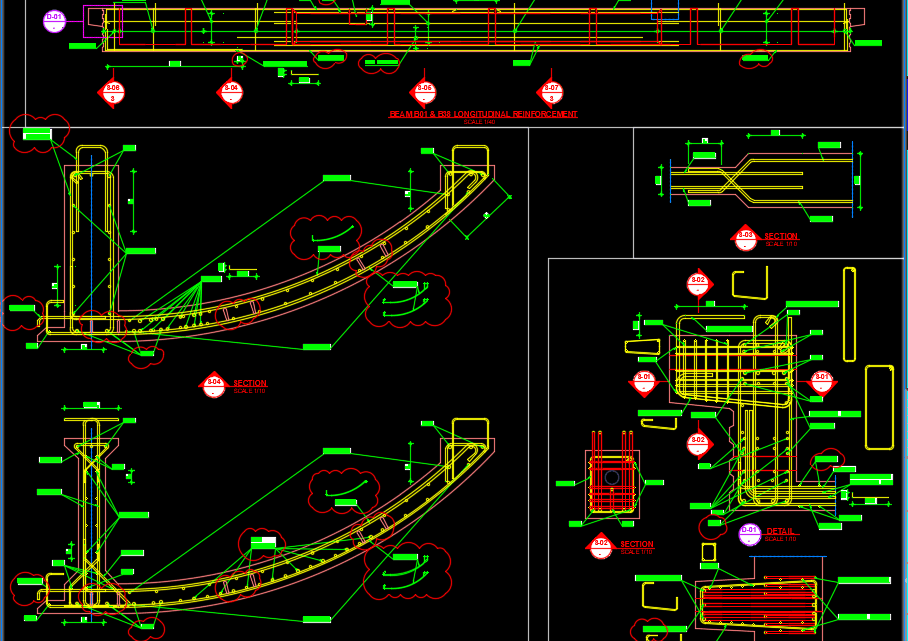
Precast Beams Reinforcement Autocad Drawing

Precast Beams Reinforcement Autocad Drawing

19 July 2025 Off By The Engineering Community

Precast Beams Reinforcement Autocad Drawing


In the world of modern construction, speed, precision, and strength are paramount. At the heart of this efficiency lies the precast concrete beam, a structural hero manufactured off-site and delivered ready for assembly. But what gives these components their incredible load-bearing capacity and durability? The answer is embedded within: a sophisticated system of reinforcement.

This article explores the crucial role of reinforcement in precast concrete beams, from the types of materials used to the immense benefits they bring to a project, offering a comprehensive look into why this technology is a cornerstone of contemporary building design.

What is a Precast Concrete Beam?

A precast concrete beam is a structural element manufactured in a controlled factory environment.[1][2] This off-site production allows for a high degree of quality control, precision, and consistency that is difficult to achieve with traditional on-site casting.[1][3] These beams, which can be shaped into various profiles like rectangular, T-beams, L-beams, or inverted T-beams, are designed to support heavy loads over various spans.[4][5][6]

The Core of Strength: Types of Reinforcement

Concrete is exceptionally strong under compression but has a very low tensile strength, meaning it can easily crack when pulled or bent.[7] To counteract this, reinforcement is embedded within the concrete, creating a composite material with superior structural properties.[7] There are two primary methods for reinforcing precast beams:

  1. Conventional Steel Reinforcement (Rebar): This is the most common method, involving the placement of steel bars, or rebar, inside the beam’s formwork before the concrete is poured.[8] Steel is an ideal partner for concrete because they have similar thermal expansion coefficients, meaning they expand and contract at similar rates with temperature changes, which prevents internal stress and cracking.[7] Welded wire fabric, a grid of steel wires, may also be used in some applications.[8]

  2. Prestressing and Post-Tensioning: This advanced technique introduces compressive forces into the beam to significantly boost its strength and ability to span longer distances.[8][9]

    • Pre-tensioning: High-strength steel strands or tendons are stretched to a specific tension before the concrete is poured around them.[8][10] Once the concrete cures and hardens, the tension in the strands is released. This transfers a compressive force into the concrete, actively working against the tensile forces the beam will experience in its lifetime.[8] This process enhances the load-carrying capacity and minimizes cracking.[11]

    • Post-tensioning: In this method, ducts are placed within the formwork, and concrete is cast around them. After the concrete has gained sufficient strength, steel tendons are threaded through the ducts, tensioned with hydraulic jacks, and then anchored at the ends of the beam.[8]

The Undeniable Advantages of Reinforced Precast Beams

The combination of precast manufacturing and advanced reinforcement offers a multitude of benefits that are reshaping the construction industry:

  • Superior Strength and Durability: Prestressing, in particular, creates beams that can handle heavier loads and span longer distances than traditionally reinforced concrete.[7][9][11] This built-in compression also significantly improves the beam’s lifespan by reducing cracks.[8][11]

  • Unmatched Quality Control: Factory settings allow for meticulous control over concrete mixing, placement, curing, and reinforcement positioning.[1][11] This consistency minimizes defects and ensures every beam meets rigorous standards.[1]

  • Accelerated Construction Schedules: Since beams are manufactured off-site while foundation and site preparation work is underway, they can be installed quickly upon arrival, dramatically reducing overall project timelines and on-site labor costs.[1][11]

  • Design Flexibility: Reinforcement allows for the creation of thinner, longer, and more complex beam shapes that would be impractical with unreinforced concrete.[8] This gives architects and engineers greater creative freedom.[8]

  • Enhanced Safety and Resistance: Properly reinforced precast beams are better equipped to withstand environmental stressors like seismic activity and high winds.[8][12]

Precast Reinforced Beams vs. Cast-in-Situ Beams

The traditional method of construction involves building formwork on-site and pouring concrete directly into it, a process known as cast-in-situ.[13][14] While effective, this method presents several challenges when compared to precasting.

Feature Precast Reinforced Beams Cast-in-Situ Beams
Manufacturing Produced off-site in a controlled factory environment.[2][10] Poured and cured on the construction site.[13][14]
Quality Control High and consistent due to factory conditions.[3] Variable and dependent on site conditions and workmanship.
Construction Speed Fast installation, reducing overall project time.[15] Slower, as it requires on-site formwork, pouring, and curing time.
Strength Often stronger, especially when prestressed, allowing for longer spans.[15][16] Standard strength, may require larger sections for similar loads.
Weather Dependency Production is independent of weather conditions.[3] Vulnerable to delays caused by rain, cold, or extreme heat.

Design and Safety Standards

The design and fabrication of precast reinforced beams are governed by strict industry codes and standards to ensure safety and performance. In the United States, the Precast/Prestressed Concrete Institute (PCI) and the American Concrete Institute (ACI), particularly ACI 318, provide the primary design guidelines.[17] In Europe, Eurocode 2 (EN 1992-1-1) is the prevailing standard.[18][19] Adherence to these codes is crucial for the structural integrity of the final building.

The Future is Precast

The use of precast beams with advanced reinforcement is more than just a construction trend; it’s a strategic shift towards more efficient, reliable, and durable building practices. By harnessing the power of factory-controlled quality and the engineered strength of prestressed and reinforced concrete, the construction industry can deliver higher-quality structures faster and more safely than ever before. For your next project, consider the built-in advantages of precast reinforced beams—the foundational choice for modern construction.

Download Link

To download more free Autocad Files please visit www.cadtemplates.org