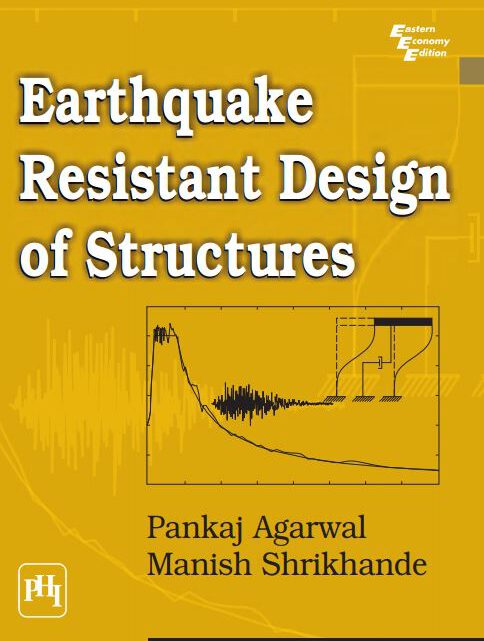
Earthquake Resistant Design of Structures Free PDF
9 January 2021Table of Contents
Earthquake Resistant Design of Structures: Principles, Methods, and Engineering Practice
Earthquake Resistant Design of Structures is a core discipline within structural engineering that focuses on protecting buildings and infrastructure from seismic forces. Rather than attempting to make structures completely rigid, modern seismic design aims to control damage, dissipate energy, and prevent catastrophic collapse during earthquakes.
This approach combines structural dynamics, material behavior, and engineering judgment to achieve resilient and safe structures.
What Is Earthquake Resistant Design?
Earthquake resistant design is the process of designing structures to:
-
Withstand seismic forces without collapse
-
Limit damage to acceptable levels
-
Protect human life
-
Maintain post-earthquake functionality when required
It recognizes that earthquakes are unpredictable and designs structures to perform reliably under extreme loading conditions.
Fundamental Principles of Earthquake Resistant Design
1. Ductility and Energy Dissipation
A key principle is ductility, which allows structures to deform without sudden failure. Ductile elements absorb seismic energy through controlled yielding, reducing force demand on the structure.
2. Structural Regularity
Regularity in plan and elevation improves seismic performance by:
-
Reducing torsional effects
-
Ensuring uniform force distribution
-
Simplifying dynamic behavior
Irregular structures require special attention and advanced analysis.
3. Capacity Design Philosophy
Capacity design ensures that:
-
Ductile elements yield first
-
Brittle failure modes are prevented
-
Damage occurs in predictable locations
This philosophy forms the backbone of modern seismic codes.
Seismic Loads and Structural Response
Earthquake resistant design considers how structures respond dynamically to ground motion, including:
-
Inertial forces generated by mass
-
Natural vibration modes
-
Resonance effects
-
Damping mechanisms
Understanding this behavior is essential for selecting appropriate structural systems and detailing strategies.
Common Structural Systems Used in Earthquake Resistant Design
Different structural systems offer varying levels of seismic resistance:
-
Moment-resisting frames
-
Shear wall systems
-
Dual systems (frames + walls)
-
Braced frames
-
Base-isolated structures
Each system is chosen based on building height, function, seismic zone, and economic considerations.
Role of Detailing in Seismic Performance
Proper detailing is as important as global analysis. Earthquake resistant detailing focuses on:
-
Confinement of concrete
-
Adequate anchorage and lap lengths
-
Strong column–weak beam behavior
-
Prevention of shear failure
Well-detailed structures perform significantly better during earthquakes, even under severe shaking.
Performance-Based Earthquake Engineering
Modern practice increasingly uses performance-based design, which evaluates how a structure performs at different earthquake intensity levels, such as:
-
Immediate occupancy
-
Life safety
-
Collapse prevention
This approach allows engineers to design structures that meet specific performance objectives beyond minimum code requirements.
Earthquake Resistant Design and Existing Structures
For existing buildings, earthquake resistant design is applied through:
-
Seismic evaluation
-
Vulnerability assessment
-
Strengthening and retrofit solutions
This is especially important for older structures designed before modern seismic codes.
Why Earthquake Resistant Design Is Critical Today
Urbanization, high-rise construction, and infrastructure expansion have increased seismic risk. Earthquake resistant design helps:
-
Reduce economic losses
-
Improve community resilience
-
Protect critical facilities
-
Enhance long-term sustainability
It is a fundamental responsibility of structural engineers in seismic regions.
Who Should Learn Earthquake Resistant Design?
This field is essential for:
-
Structural and civil engineers
-
Seismic design consultants
-
Graduate students in earthquake engineering
-
Engineers involved in assessment and retrofitting
A strong understanding of earthquake resistant design improves both technical competence and professional judgment.
Final Thoughts
Earthquake resistant design of structures is not about eliminating damage, but about controlling it intelligently. By combining sound engineering principles, proper detailing, and an understanding of seismic behavior, engineers can design structures that save lives and perform reliably during earthquakes.