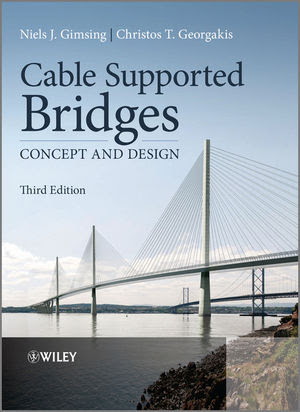
Cable Supported Bridges: Concept and Design – Book Review (3rd Edition)
13 January 2021Table of Contents
Cable Supported Bridges: Concept and Design – Book Review (3rd Edition)
Cable Supported Bridges: Concept and Design (Third Edition) by Niels J. Gimsing and Christos T. Georgakis is one of the most authoritative references on the analysis and design of modern long-span bridges, including cable-stayed and suspension bridges.
Published by Wiley, this book is widely used by bridge engineers, researchers, and graduate students specializing in bridge engineering and structural dynamics.
Overview of the Book
This book provides a comprehensive and structured explanation of the structural behavior, design principles, and construction concepts of cable-supported bridge systems. It combines theoretical fundamentals with practical design considerations, making it suitable for both academic study and professional practice.
The third edition reflects modern bridge design practices, updated codes, and real-world examples from landmark bridge projects around the world.
Types of Bridges Covered
The book focuses primarily on:
-
Cable-stayed bridges
-
Suspension bridges
-
Hybrid and special long-span bridge systems
It explains how load paths, cable forces, deck stiffness, pylons, and foundations interact to form efficient and safe bridge structures.
Key Topics Included
Some of the main subjects covered in the book include:
-
Structural behavior of cable-supported bridges
-
Cable systems and force distribution
-
Deck and girder systems
-
Pylon and tower design
-
Construction stages and erection methods
-
Geometric nonlinearity and second-order effects
-
Aerodynamic stability and dynamic behavior
-
Serviceability and ultimate limit state design
-
Case studies of real bridge projects
The book places strong emphasis on understanding behavior before applying design equations, which is essential for complex bridge structures.
Strengths of the Book
This reference is highly valued because it:
-
Explains complex structural behavior in a clear and logical way
-
Connects theory with real bridge applications
-
Addresses both analysis and construction aspects
-
Covers dynamic effects, which are critical for long-span bridges
-
Is suitable for advanced design beyond basic bridge codes
It is especially useful for engineers involved in conceptual design and preliminary sizing of major bridge projects.
Who Should Read This Book?
This book is ideal for:
-
Bridge and structural engineers
-
Engineers working on long-span or cable-supported bridges
-
Graduate and postgraduate civil engineering students
-
Researchers in bridge engineering and structural mechanics
-
Engineers preparing for advanced bridge design roles
It is less focused on routine bridge design and more on high-level engineering judgment and understanding.
Relevance in Modern Bridge Engineering
Cable-supported bridges represent some of the most iconic and technically demanding structures in civil engineering. With increasing span lengths and architectural demands, understanding structural behavior, stability, and construction sequencing is essential.
This book helps engineers:
-
Make informed conceptual design decisions
-
Understand limitations of simplified models
-
Improve safety and economy of bridge designs
-
Communicate effectively with multidisciplinary bridge teams
How to Obtain the Book Legally
To access the complete content, figures, and design explanations, the book should be obtained through official and authorized sources, such as:
-
The publisher (Wiley)
-
Academic libraries
-
Engineering bookstores
-
Trusted online retailers
Using official sources ensures access to the full technical value of the book.
Final Thoughts
Cable Supported Bridges: Concept and Design is a cornerstone reference for anyone serious about modern bridge engineering. Its balance of theory, practice, and real-world insight makes it a long-term investment for engineers working on complex and high-profile bridge projects.
For engineers seeking to move beyond standard bridge design and into advanced structural systems, this book remains an essential resource.