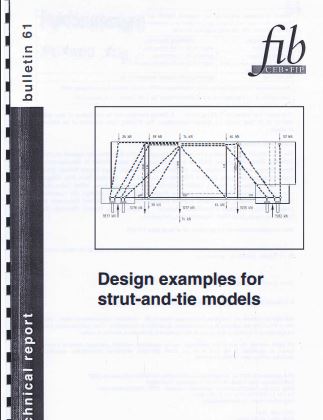
Design Examples for Strut-and-Tie Models – Reference Guide
23 January 2021Table of Contents
Design Examples for Strut-and-Tie Models – Reference Guide
Design Examples for Strut-and-Tie Models is a technical reference focused on the application of the strut-and-tie method (STM) for the design of reinforced concrete structures, especially discontinuity regions (D-regions) where traditional beam theory is not applicable.
This type of resource is widely used by structural engineers, concrete designers, and graduate students.
Reference details
-
Title: Design Examples for Strut-and-Tie Models
-
Field: Structural Engineering / Reinforced Concrete Design
-
Focus: Strut-and-tie modeling and practical design examples
-
Language: English
-
Format: Technical reference / design guide
What this guide covers
The guide demonstrates how to apply strut-and-tie modeling principles to real reinforced concrete design problems.
Typical topics include:
-
Fundamentals of strut-and-tie modeling
-
Identification of B-regions and D-regions
-
Load paths and force flow in concrete structures
-
Design of struts, ties, and nodal zones
-
Anchorage and detailing requirements
-
Deep beams and transfer girders
-
Corbels and brackets
-
Pile caps and footing systems
-
Openings in reinforced concrete members
The examples help translate theory into practical design decisions.
Why this reference is useful
-
Helps engineers understand force flow in concrete structures
-
Essential for designing non-standard or complex RC elements
-
Supports compliance with modern concrete design codes (ACI, Eurocode)
-
Improves safety and clarity in detailing reinforced concrete
This makes it especially valuable for advanced reinforced concrete design.
Who should use this guide?
This reference is recommended for:
-
Structural and civil engineers
-
Reinforced concrete designers
-
Graduate students in structural engineering
-
Engineers working on deep beams, pile caps, and corbels
-
Professionals dealing with D-region design problems
Pros and limitations
Pros
-
Practical, example-based approach
-
Focus on real structural problems
-
Strong support for modern design methods
Limitations
-
Requires prior knowledge of reinforced concrete behavior
-
Not a substitute for official design codes
Official and legal access
For legal access, design standards, and reference materials, always use official publishers, professional organizations, or institutional libraries.
This site does not host or distribute copyrighted books or manuals.
Final note
This article is a review and reference guide only.
We do not provide free or pirated copies of design manuals. Always rely on official standards and professional resources for structural design work.