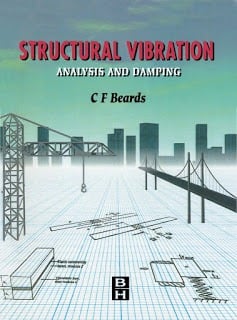
Structural Vibration Analysis and Damping
5 December 2017Table of Contents
Structural Vibration: Analysis and Damping by C. F. Beards
Vibration is one of the most overlooked problems in structural engineering—until it becomes a serious issue. A structure may be perfectly safe in terms of strength, yet still fail in serviceability because of excessive vibration, discomfort, noise, resonance, fatigue cracking, or equipment malfunction.
That’s why Structural Vibration: Analysis and Damping by C. F. Beards is such an important and highly technical reference. It focuses on the real mechanics behind vibration behavior and damping—helping engineers move beyond basic formulas and understand vibration as a structural performance problem.
Quick Overview
Title: Structural Vibration: Analysis and Damping
Author: C. F. Beards
Field: Structural dynamics, vibration analysis, damping systems
Best for: Structural engineers, mechanical engineers, dynamic analysts, graduate students, researchers
Use cases: Building vibration serviceability, machine foundations, pedestrian bridges, resonance checks, fatigue risk, damping design
What This Book Covers
This book is not a “simple introduction” to vibration—it is designed as a deep and practical reference for vibration analysis and control. It typically covers:
-
Vibration fundamentals
-
free vibration and forced vibration
-
resonance behavior
-
frequency response concepts
-
-
Single-degree and multi-degree systems
-
modal properties
-
coupled vibration behavior
-
-
Damping mechanisms
-
viscous damping models
-
structural (hysteretic) damping concepts
-
real damping behavior in materials and systems
-
-
Vibration of structural components
-
beams, plates, and frames under dynamic loading
-
-
Response prediction
-
time-domain and frequency-domain approaches
-
excitation types and response estimation
-
-
Practical vibration control
-
damping strategies
-
vibration reduction concepts and design thinking
-
The title is accurate: it’s strongly focused on both analysis and damping, which is essential in modern vibration serviceability design.
What I Liked Most (Strengths)
1) Strong explanation of damping (a difficult topic)
Many vibration books explain natural frequency well—but damping is often treated as a “small parameter” and ignored. In real structures, damping controls:
-
vibration amplitude
-
decay rate after excitation
-
serviceability response under people, wind, and machinery
-
fatigue accumulation under repeated motion
This book gives damping the attention it deserves.
2) Very useful for engineers working on real vibration issues
This book is valuable if you work on:
-
long-span floors
-
footbridges and pedestrian vibration
-
industrial structures with rotating machinery
-
crane-supporting structures
-
towers and slender frames
-
any structure sensitive to resonance
It helps you understand not only “how to calculate,” but also “how to solve” vibration problems.
3) Strong bridge between theory and practical response prediction
It supports the kind of analysis engineers need when deciding:
-
Do we need more stiffness?
-
Should we add damping?
-
Is the vibration risk due to resonance or excitation level?
-
What response is acceptable for comfort and function?
What Could Be Better (Limitations)
1) Not beginner-friendly
If you’re new to vibration, the book may feel heavy. It’s best used after you already understand basic structural dynamics concepts.
2) Not a design-code manual
Vibration serviceability is often governed by guidelines and project criteria. This book explains the mechanics and analysis methods, but you still need local standards or client limits to define what “acceptable vibration” means.
Who Should Read This Book?
Highly recommended for:
-
graduate structural or mechanical engineering students
-
engineers doing vibration analysis of floors and bridges
-
dynamic specialists and consultants
-
professionals working on industrial vibration or fatigue problems
-
engineers developing damping solutions or vibration control strategies
Less ideal for:
-
beginners who want an easy first vibration textbook
-
engineers looking only for static analysis and code design procedures
Final Verdict
Structural Vibration: Analysis and Damping by C. F. Beards is a serious technical reference for engineers who want to understand vibration properly—and control it effectively. Its biggest strength is how it explains damping and real vibration response in engineering structures, making it a valuable resource for both advanced learners and professionals solving vibration problems.