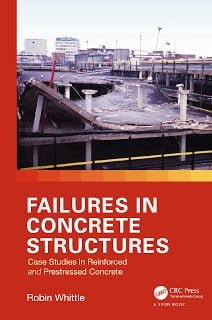
Failures in Concrete Structures: Case Studies in Reinforced and Prestressed Concrete by Robin Whittle
8 December 2017Table of Contents
Failures in Concrete Structures: Case Studies in Reinforced and Prestressed Concrete by Robin Whittle
Concrete is often seen as “permanent,” but every experienced engineer knows the reality: concrete structures fail—sometimes slowly through deterioration, and sometimes suddenly due to design mistakes, construction errors, poor detailing, or unexpected loading. The most powerful way to become a better structural engineer is to study these failures, because they teach lessons that formulas alone cannot.
That’s what makes Failures in Concrete Structures: Case Studies in Reinforced and Prestressed Concrete by Robin Whittle such a valuable resource. Instead of presenting idealized design scenarios, it focuses on real failures, explaining what went wrong, how it happened, and what engineers should do differently.
Quick Overview
Title: Failures in Concrete Structures: Case Studies in Reinforced and Prestressed Concrete
Author: Robin Whittle
Publisher: CRC Press
Field: Structural engineering, forensic engineering, reinforced & prestressed concrete
Best for: Structural engineers, design reviewers, site engineers, forensic engineers, students
Use cases: Learning from failure case studies, improving detailing, design checking, construction QA/QC, risk prevention
What This Book Covers
This book is built around case studies, which makes it different from standard reinforced concrete design textbooks. It typically explores:
-
Common failure modes in reinforced concrete
-
shear failures
-
punching failures
-
inadequate anchorage and development length
-
reinforcement detailing mistakes
-
-
Prestressed concrete failure mechanisms
-
tendon issues, anchorage failures, grouting problems
-
time-dependent effects (creep, shrinkage, relaxation)
-
-
Construction and execution failures
-
poor curing and early-age cracking
-
wrong bar placement / missing reinforcement
-
inadequate temporary works and sequencing mistakes
-
-
Material and durability failures
-
corrosion and cover problems
-
chemical attack and long-term degradation
-
-
Collapse and near-miss lessons
-
how small errors compound into catastrophic outcomes
-
warning signs and missed red flags
-
-
Engineering lessons learned
-
what checks could have prevented the failure
-
what details typically trigger risk
-
The book’s strongest contribution is the way it helps engineers connect “small” issues—like detailing or site quality—to big structural outcomes.
What I Liked Most (Strengths)
1) Case-study learning builds real engineering judgment
There’s a difference between knowing design rules and developing structural judgment. Case studies teach you to recognize patterns:
-
repeated failure triggers
-
dangerous assumptions
-
details that look “minor” but are actually critical
-
construction practices that raise risk
This is priceless knowledge, especially for engineers who review designs or work on site.
2) Improves design checking and QA/QC mindset
If you’re involved in checking, review, or construction supervision, this book helps sharpen your ability to ask the right questions:
-
Is the load path clear?
-
Are shear-critical zones properly reinforced?
-
Do we have adequate anchorage and confinement?
-
Are temporary conditions safe?
-
Are prestress details realistically constructible?
3) Useful for both reinforced and prestressed engineers
Many failure books focus only on RC or only on prestressed. This one is valuable because it addresses both—helping engineers understand how different systems fail differently.
What Could Be Better (Limitations)
1) Not a code design manual
This book teaches engineering lessons and failure mechanisms, but it won’t replace concrete design standards or provide step-by-step member design procedures.
2) Some cases may be region-specific
Failure studies often relate to local practices, standards, and construction methods. The lessons are still broadly useful, but engineers should interpret details in the context of their regional codes and site realities.
Who Should Read This Book?
Highly recommended for:
-
structural engineers working with reinforced/prestressed concrete
-
design reviewers and checkers
-
site engineers and QA/QC engineers
-
forensic and repair engineers
-
students who want real-world understanding beyond theory
Less ideal for:
-
readers who only want design equations and solved member problems
-
beginners who have not yet learned basic RC behavior (though it can still be motivating)
Final Verdict
Failures in Concrete Structures by Robin Whittle is an excellent learning tool for anyone serious about designing and building safer concrete structures. It teaches that failures rarely come from one big mistake—they come from small weaknesses that align, often through poor detailing, incorrect assumptions, or construction realities that weren’t considered.