Bridge Engineering – Types of Bridges
25 January 2026Table of Contents
Bridge Engineering –Types of Bridges
Over the last several thousand years, bridges have played one of the most important roles in the development of early civilizations—supporting the spread of knowledge, local and global trade, and the rise of transportation networks.
Initially made from the simplest materials and designs, bridges steadily evolved to carry wider decks and span greater distances over rivers, gorges, valleys, uneven terrain, and dense city infrastructure.
From the Greek Bronze Age (around the 13th century BC) to the rise of stone arch bridges, and later the widespread adoption of iron, steel, reinforced concrete, and advanced composites, bridge engineering has continuously adapted to new construction capabilities and modern demands.
In 2026, bridges are no longer evaluated only by strength and span length. Today, modern bridge design must also consider:
-
Long-term durability and lifecycle cost
-
Climate resilience (flooding, corrosion, wind, heat cycles)
-
Seismic performance
-
Smart monitoring technologies (SHM sensors)
-
Accelerated construction methods to reduce traffic disruption
-
Sustainability and low-carbon materials
To serve many structural roles and traffic conditions, bridges vary in appearance, load capacity, structural systems, movable components, and material selection.
Bridges by Structure
A bridge’s structural system determines how it distributes internal forces, including:
-
Compression
-
Tension
-
Shear
-
Bending (flexure)
-
Torsion
While every bridge experiences these forces, different bridge types are optimized to carry them in different ways. Some designs concentrate forces through major elements (like arches or cables), while others distribute loads across many members (like trusses).
Arch Bridges
Arch bridges use a curved arch as their main structural element (the arch sits below the deck, not above it). Loads are transferred into compression through the arch and carried into the ground through the abutments and sometimes additional mid-span piers.
Key structural components:
-
Abutments
-
Piers (when applicable)
-
The arch itself (compression-driven)
Arch bridges are always fixed (non-moving), and can support pedestrians, vehicles, rail, and even act as aqueducts.
Common materials:
-
Masonry stone
-
Concrete
-
Timber
-
Wrought iron / cast iron
-
Structural steel
Famous examples include:
-
Old Bridge (Stari Most), Mostar
-
Hell Gate Bridge, New York City
- Galena Creek Bridge
The oldest stone arch bridge still in use is often cited as the Arkadiko Bridge in Greece (over 3,000 years old). The Solkan Bridge in Slovenia is one of the longest stone arch spans, reaching about 220 meters.
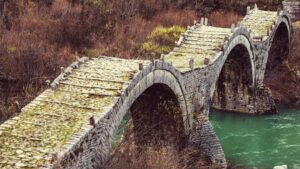

Galena Creek Bridge, a cathedral arch bridge
Beam Bridges
Beam bridges are the simplest and most widely used bridge type, consisting of one or more horizontal beams (girders) that span between abutments or rest on intermediate piers for longer crossings. In beam bridge design, the load from traffic and the deck is transferred downward, creating bending (flexural stresses) and shear forces, which are then carried safely into the supports.
Because of their straightforward structure and cost-effective construction, beam bridges are among the oldest bridge designs in history, originally formed by placing timber logs across small rivers or ditches. With the development of modern engineering, beam bridges evolved into high-capacity systems built using steel girders, prestressed concrete, and box girder sections.
Today, common beam bridge variations include simple beam bridges, girder bridges, plate girder bridges, and box girder bridges, often constructed as segmental decks with equal or variable lengths, including inclined or V-shaped configurations. One of the most famous examples is the Lake Pontchartrain Causeway in Louisiana, one of the longest beam bridge structures in the world at 23.83 miles (38.35 km).
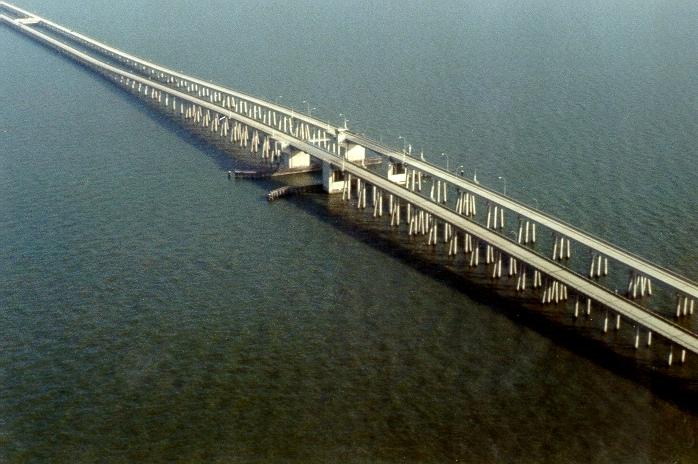
Lake Pontchartrain Causeway bridge
Truss Bridges
Truss bridges – is a very popular bridge design that uses a diagonal mesh of most often triangle-shaped posts above the bridge to distribute forces across almost entire bridge structure. Individual elements of this structure (usually straight beams) can endure dynamic forces of tension and compression, but by distributing those loads across entire structure, entire bridge can handle much stronger forces and heavier loads than other types of bridges.
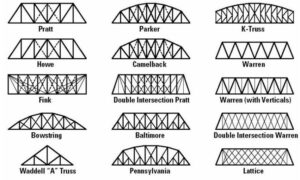
Common types of truss bridges
The two most common truss designs are the king posts (two diagonal posts supported by single vertical post in the center) and queen posts (two diagonal posts, two vertical posts and horizontal post that connect two vertical posts at the top). Many other types of the truss are in use – Allan, Bailey, Baltimore, Bollman, Bowstring, Brown, Howe, Lattice, Lenticular, Pennsylvania, Pratt, and others.
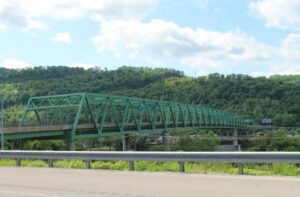
Admiral T.J. Lopez Bridge
Cantilever Bridges
Cantilever bridges – are somewhat similar in appearance to arch bridges, but they support their load, not through a vertical bracing but trough diagonal bracing with horizontal beams that are being supported only on one end. The vast majority of cantilever bridges use one pair of continuous spans that are placed between two piers, with beams meeting on the center over the obstacle that bridge spans (river, uneven terrain, or others). Cantilever bridge can also use mid-bridge pears are their foundation from which they span in both directions toward other piers and abutments.

Howrah Bridge, Kolkata
The size and weight capacity of the cantilever bridge impact the number of segments it uses. Simple pedestrian crossings over very short distances can use simple cantilever beam, but larger distances can use either two beams coming out of both abutments or multiple center piers. Cantilever bridges cannot span very large distances. They can be bare or use truss formation both below and above the bridge, and most popular constriction material are structural steel, iron, and prestressed concrete.
Same of the most famous cantilever bridges in the world are Quebec Bridge in Canada, Forth Bridge in Scotland and Tokyo Gate bridge in Japan.

Tokyo Gate bridge in Japan
Tied Arch Bridges
Tied arch bridges – are similar in design to arch bridges, but they transfer the weight of the bridge and traffic load to the top chord that is connected to the bottom cords in bridge foundation. The bottom tying cord can be reinforced decking itself or a separate deck-independent structure that interfaces with tie-rods.

Generic tied-arch bridge with a movable support on the right side
They are often called bowstring arches or bowstring bridges and can be created in several variations, including shouldered tied-arch, multi-span discrete tied-arches, multi-span continuous tied-arches, single tied-arch per span and others. However, there is a precise differentiation between tied arch bridges and bowstring arch bridges – the latter use diagonally shaped members who create a structure that transfer forces similar to in truss bridges.
Tied arch bridges can be visually very stunning, but they bring with them costly maintenance and repair.

The Fort Pitt Bridge is a tied-arch bridge. The arches terminate atop slender raised piers and are tied by the road deck structure
Suspension Bridges
Suspension bridges – utilize spreading ropes or cables from the vertical suspenders to hold the weight of bridge deck and traffic. Able to suspend decking over large spans, this type of bridge is today very popular all around the world.
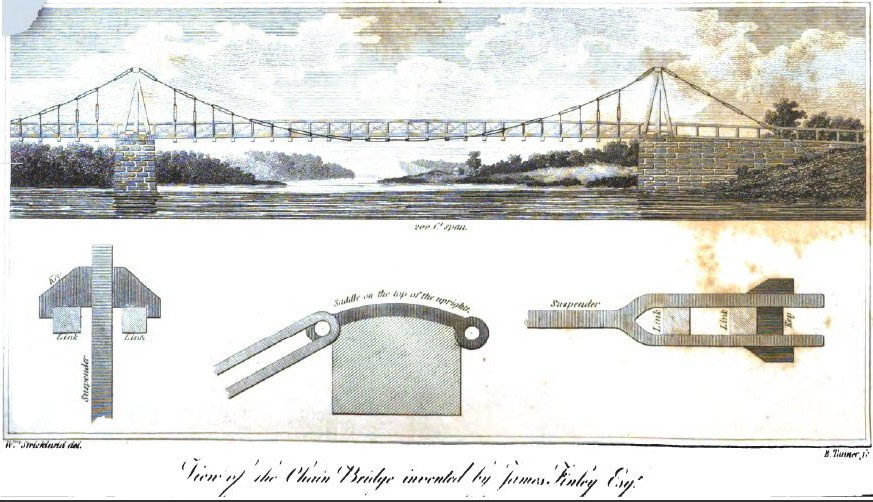
View of the Chain Bridge invented by James Finley Esq.” (1810) by William Strickland. Finley’s Chain Bridge at Falls of Schuylkill (1808) had two spans, 100 feet and 200 feet
Originally made even in ancient times with materials such as ropes or vines, with decking’s of wood planks or bamboo, the modern variants use a wide array of materials such as steel wire that is either braided into rope or forged or cast into chain links. Because only abutments and piers (one or more) are fixed to the ground, the majority of the bridge structure can be very flexible and can often dramatically respond to the forces of wind, earthquake or even vibration of on-foot or vehicle traffic.
Some of the most famous examples of suspension bridges are Golden Gate Bridge in San Francisco, Akashi Kaikyō Bridge in Japan, and Brooklyn Bridge in New York City.

Akashi Kaikyō Bridge in Japan
Cable-Stayed Bridges
Cable-stayed bridges – use deck cables that are directly connected to one or more vertical columns (called towers or pylons) that can be erected near abutments or in the middle of the span of the bridge structure. Cables are usually connected to columns in two ways – harp design (each cable is attached to the different point of the column, creating the harp-like “strings” and “fan” designs (all cables connect to one point at the top of the column). This is a very different type of cable-driven suspension than in suspension bridges, where decking is held with vertical suspenders that go up to main support cable.
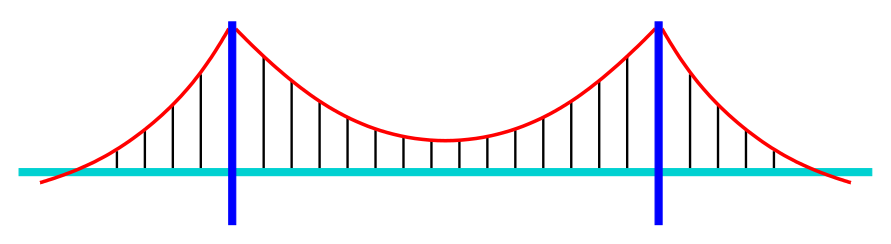
Suspension bridge

Cable-stayed bridge, fan design
Originally constructed and popularized in the 16th century, today cable-stayed bridges are a popular design that is often used for spanning medium to long distances that are longer than those of cantilever bridges but shorter than the longest suspension bridges. The most common build materials are steel or concrete pylons, post-tensioned concrete box girders and steel rope. These bridges can support almost every type of decking (only not including heavy rail) and are used extensively all around the world in several construction variations.
The famous Brooklyn Bridge is a suspension bridge, but it also has elements of cable-stayed design.

Brooklyn Bridge
Fixed or Moveable Types
The vast majority of all bridges in the world are fixed in place, without any moving parts that forces them to remain in place until they are demolished or fall due to unforeseen stress or disrepair. However, some spaces are in need of multi-purpose bridges which can either have movable parts or can be completely moved from one location to another. Even though these bridges are rare, they serve an important function that makes them highly desirable.
Fixed Bridges
Fixed – Majority of bridges constructed all around the world and throughout our history are fixed, with no moveable parts to provide higher clearance for river/sea transport that is flowing below them. They are designed to stay where they are made to the time they are deemed unusable due to their age, disrepair or are demolished. Use of certain materials or certain construction techniques can instantly force bridge to be forever fixed. This is most obvious with bridges made out of construction masonry, suspension and cable-stayed bridges where a large section of decking surface is suspended in the air by the complicated network of cables and other material.
Small and elevated bridges like Bridge of Sighs, ancient stone aqueducts of Rome such as Pont du Gard, large medieval multi-arched Charles Bridge, and magnificent Golden Gate Bridge are all examples of bridges that are fixed.
Temporary Bridges
Temporary bridges – Temporary bridges are made from basic modular components that can be moved by medium or light machinery. They are usually used in military engineering or in circumstances when fixed bridges are repaired, and can be so modular that they can be extended to span larger distances or even reinforced to support heightened loads. The vast majority of temporary bridges are not intended to be used for prolonged periods of time on single locations, although in some cases they may become a permanent part of the road network due to various factors.
The simples and cheapest temporary bridges are crane-fitted decking made out of construction wood that can facilitate passenger passage across small spans (such as ditches). As the spans go longer and loads are heightened, prefabricated bridges made out of steel and iron have to be used. The most capable temporary bridges can span even distances of 100m using reinforced truss structure that can facilitate even heavy loads.
Moveable Bridges
Moveable bridges – Moveable bridges are a compromise between the strength, carrying capacity and durability of fixed bridges, and the flexibility and modularity of the temporary bridges. Their core functionality is providing safe passage of various types of loads (from passenger to heavy freight), but with the ability to move out of the way of the boats or other kinds of under-deck traffic which would otherwise not be capable of fitting under the main body of the bridge.
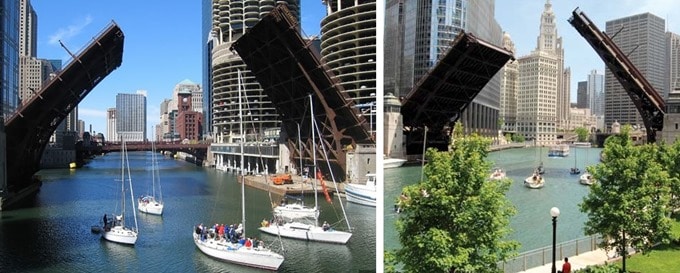
Movable Bridge in Chicago, USA
Most commonly, movable bridges are made with simple truss or tied arch design and are spanning rivers with little to medium clearance under their main decks. When the need arises, they can either lift their entire deck sharply in the air or sway the deck structure to the side, opening the waterway for unrestricted passage of ships. While the majority of the moveable bridges are small to medium size, large bridges also exist.
The most famous moveable bridge in the world is London Tower Bridge, whose clearance below the decking rises from 8.6m to 42.5m when opened.
Types by Use
When thinking about bridges, everyone’s first thought are structures that facilitate easy passenger and car traffic across bodies of water or unfriendly terrain. However, bridges can be versatile and can support many different types of use. Additionally, some bridges are designed in such way to support multiple types of use, combining, for example, multiple car traffic lanes and pedestrian or bicycle passageways (such as a present on the famous Brooklyn Bridge in New York City).
Pedestrian Bridges
Pedestrian bridges are among the oldest bridge types ever built. They were originally designed to help people cross small rivers, gaps, or difficult terrain. Today, pedestrian bridges are most common in urban areas. They are also used in places where vehicle access is limited, such as mountains, forests, or swamps.
Because foot and bicycle traffic creates less load than cars or trains, these bridges do not need to support heavy weight. This allows designers to create structures that are more elegant, sleek, and visually integrated into their surroundings.
In some cases, pedestrian bridges can also be built with cheaper or less durable materials. Many modern pedestrian-only bridges use advanced materials. Tourist bridges may include more exotic features, such as transparent polymer decking, which allows people to see the landscape below.

Charles Bridge as viewed from Petřínská rozhledna
While the majority of modern pedestrian bridges were made from the start to facilitate only on-foot access (such as Venice’s Ponte Vecchio and Rialto bridge), other bridges can be transformed from other purposes to pedestrian-only function (such as Prague’s historic Charles bridge).
Car Traffic
Car Traffic – This is the most common usage of the bridge, with two or more lanes designed to carry car and truck traffic of various intensities. Modern large bridges usually feature multiple lanes that facilitate travel in a single direction, and while the majority of bridges have a single decking dedicated to car traffic, some can even have an additional deck, enabling each deck to be focused on providing travel in a single direction.
Double-decked Bridges
Double-decked bridges – Multi-purpose bridges that provide an enhanced flow of traffic across bodies of water or rough terrain. Most often they have a large number of car lanes, and sometimes have dedicated area for train tracks. For example, in addition to multiple car lanes on the main decking, famous Brooklyn Bridge in NYC features an isolated bicycle path.
Train Bridges
Train bridges are built specifically to carry one or more railway tracks. In some cases, the tracks may also run alongside another deck type, or sit on a different deck level. After road bridges, train bridges are the second most common bridge type.
The first train bridges were built during the early years of the European Industrial Revolution. They helped move freight faster between ore mines and ironworks factories. As passenger locomotives became safer and more reliable, railway networks expanded rapidly across Europe, the United States, and Asia. This growth created the need for thousands of railway bridges in many different sizes and span lengths.
Pipeline Bridges
Pipeline Bridges – Less common as a standalone bridge type, pipeline bridges are constructed to carry pipelines across water or inaccessible terrains. Pipelines can carry water, air, gas and communication cables. In modern times, pipeline networks are usually incorporated in the structure of existing or newly built bridges that also house regular decking that facilitates pedestrian, car or railway transport.

A pipeline bridge carrying the Trans-Alaska Pipeline
Pipeline bridges are usually very lightweight and can be supported only with the basic suspension bridge construction designs. In many cases, they are also equipped with walkways, but they are almost exclusively dedicated for maintenance purposes and are not intended for public use.
Aqueducts
Aqueducts are ancient bridge-like structures. They are part of larger viaduct networks. Their purpose is to carry water from water-rich areas to dry cities, sometimes over long distances. Aqueducts must keep a low but constant drop in elevation along the water channel. For this reason, they are built with great precision. Some aqueducts also need to reach high elevations. At the same time, they must stay rigid while spanning large distances. The largest aqueducts are made of stone. They can include multiple tiers of arched bridges stacked on top of each other.
The modern equivalent of aqueduct bridges is the pipeline bridge. However, ancient viaduct networks relied on gravityto move water. Modern pipeline networks use electric pumps to transport water and other materials.
Commercial Bridges
Commercial bridges are bridges that include commercial spaces such as shops and restaurants. They were most common in medieval cities, where they benefited from constant pedestrian traffic. Today, commercial bridges are rarely built, although several notable examples can still be found in modern India. The city of Bratislava (Slovakia) also features a road bridge with a large tower that includes a restaurant at the top.
Medieval bridges remain the most famous for this purpose. Italy is home to two of the best-known commercial bridges in the world. The first is the iconic Ponte Vecchio in the center of Florence. The second is the bright white Rialto Bridge, which spans the scenic Grand Canal in Venice. Both bridges are lined with shops selling tourist souvenirs and jewelry.
Types by Materials
The core function of a bridge is to span a stable deck that carries pedestrians, vehicles, or trains. At the same time, it must support its own structural weight and the constant load of traffic. It also has to resist natural forces that gradually reduce durability over time, such as weather, corrosion, and wear. The materials used in bridge construction play a major role in strength, lifespan, and maintenance needs. In the case of historic bridges, they also affect long-term restoration work. Below is a breakdown of the most common materials used in both traditional and modern bridge engineering.
Natural Materials
Bridges of natural materials – The first bridges ever made were constructed from unprocessed natural materials, starting from simple wooden logs that were placed across small rivers or ditches, to the large rope-tied bridges that are constructed over large canyons and mountain ranges in inhospitable areas of Asia.
Wood
Wood (Wooden bridges) – Wood is an excellent material that can be used for the creation of small to medium-sized bridges that are best suited for pedestrian or low-weight car transport. In modern times, wooden bridges are most commonly found for spanning short distances or being used to transport people, cars, and livestock over rough terrain or small rivers in Covered Bridges.
Stone
Stone (Stone bridges) – Stone is a highly durable natural material used to build bridges that can last for centuries. Large stone bridge structures can even be built without concrete. A famous example is the Pont du Gard aqueduct in southern France. It relies on the weight of individual stone blocks to remain stable.
This structure stands 48.8 m high and stretches 275 m long, and it has remained in place for nearly 2,000 years.
Concrete and Steel
Concrete and Steel bridges – Concrete and steel are durable, long-lasting, and highly versatile modern materials. They are used to build countless types of bridge designs. When combined with cables and other modern components, they can support a wide range of spans and loads. Today, concrete and steel bridges make up the majority of bridges used for public transport, including pedestrian, road, and railway traffic.
Advanced Materials
Bridges of advanced materials – As decades go on, modern industry enables bridge builders to gain access to wide array of advanced materials that offer noticeable advantages over traditional construction processes.