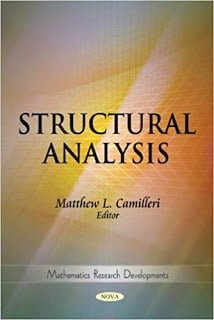
Structural Analysis (Edited by Matthew L. Camilleri)
17 November 2017Table of Contents
Structural Analysis (Edited by Matthew L. Camilleri)
Structural analysis is the foundation of everything in structural engineering. Before you design reinforcement, select steel sections, or finalize drawings, you must first understand how the structure behaves under load: internal forces, deflections, stability, and load distribution.
That’s what makes Structural Analysis (edited by Matthew L. Camilleri) an interesting and useful reference—especially for readers who want more than a standard undergraduate textbook. As part of the Mathematics Research Developmentsseries, this book leans toward a more academic and research-driven perspective, offering structural analysis through a deeper mathematical and analytical lens.
Quick Overview
Title: Structural Analysis
Editor: Matthew L. Camilleri
Series: Mathematics Research Developments
Publisher: Nova
Field: Structural analysis + analytical/mathematical methods
Best for: Graduate students, researchers, advanced learners, engineers who want deeper theoretical understanding
Use cases: Structural modeling, advanced analysis concepts, research support, mathematical foundations of structural mechanics
What This Book Covers
Unlike typical “one-author” structural analysis textbooks, this is an edited volume, meaning it generally includes different chapters that explore analysis concepts from multiple viewpoints. It is likely to include topics such as:
-
Core structural analysis theory
-
equilibrium and compatibility
-
force method and displacement method concepts
-
-
Advanced structural behavior
-
stability and buckling concepts
-
complex structural response mechanisms
-
-
Mathematical and computational viewpoints
-
formulations behind structural modeling
-
analytical approaches for structural response
-
-
Research-style discussion
-
methods and developments beyond basic classroom treatment
-
This makes it a book that supports readers aiming to strengthen the “theory behind the tools.”
What I Liked Most (Strengths)
1) More depth than standard textbooks
If you already know the basics of beams, frames, and trusses, this book can feel like a step up—helping you explore analysis through a more advanced framework.
It can be a useful bridge between:
-
undergraduate structural analysis
and -
research-level structural mechanics and modeling
2) Helpful for engineers working with advanced modeling tools
If you use FEM software or complex structural analysis programs, deeper theoretical understanding can improve your ability to:
-
interpret results correctly
-
recognize unrealistic model outputs
-
understand why numerical methods behave the way they do
-
justify assumptions in reports
3) Good for graduate-level study or reference use
Because it’s a collected volume, it can serve as a reference where you consult certain chapters based on your research or professional focus.
What Could Be Better (Limitations)
1) Not ideal as a first structural analysis textbook
If you’re learning structural analysis for the first time, you may find it too advanced or less “step-by-step” than more traditional books.
2) Chapter style can vary
Edited academic volumes can feel inconsistent chapter-to-chapter, since different authors may use different notation, assumptions, or levels of depth.
Who Should Read This Book?
Recommended for:
-
graduate engineering students
-
researchers working on structural mechanics topics
-
engineers who want deeper mathematical understanding of structural analysis
-
readers supporting academic writing or technical research reviews
Less ideal for:
-
first-year civil engineering students
-
engineers who only want quick worked examples and exam practice
-
designers who need primarily code-based structural design procedures
Final Verdict
Structural Analysis (edited by Matthew L. Camilleri) is a more advanced, academically oriented book that supports deeper understanding of structural analysis methods and mathematical foundations. It’s best suited for graduate-level learning, research, and professionals who want to understand the theory behind structural modeling—especially when working with complex analysis tools.