Best Airports in the World (2026)
14 February 2026Table of Contents
Best Airports in the World (2026): Civil Engineering, Architecture & Construction Innovation
Airports in 2026 are no longer just transportation hubs — they are mega-infrastructure projects showcasing the highest levels of civil engineering, structural innovation, sustainable construction, and architectural excellence. The world’s best airports are ranked not only for passenger experience but also for engineering resilience, seismic performance, mega-span structures, digital construction methods, and climate-adaptive design.
This in-depth guide examines the best airports in the world in 2026, focusing specifically on:
-
Construction techniques
-
Structural systems
-
Foundation engineering
-
Sustainability strategies
-
Architectural uniqueness
-
Infrastructure rankings
2026 Global Ranking: Engineering & Infrastructure Leaders
Based on global aviation performance, infrastructure capability, sustainability metrics, and architectural innovation, the top airports in 2026 include:
-
Singapore Changi Airport (SIN)
-
Hamad International Airport, Doha (DOH)
-
Tokyo Haneda Airport (HND)
-
Incheon International Airport (ICN), South Korea
-
Istanbul Airport (IST), Turkey
-
Dubai International Airport (DXB)
-
Beijing Daxing International Airport (PKX)
These airports represent the highest standards in airport civil engineering and architectural design worldwide.
1. Singapore Changi Airport (SIN)
The Gold Standard in Sustainable Airport Architecture
Architectural & Structural Innovation
Singapore Changi Airport, consistently ranked #1 globally in 2026, is a benchmark in integrating engineering with biophilic architecture.
The Jewel Changi complex features:
-
One of the world’s largest glass-and-steel grid shell domes
-
Long-span steel diagrid roof systems
-
ETFE and laminated high-performance glazing
-
Integrated rainwater harvesting engineering
Mega-Span Roof Engineering
The dome structure operates using a steel space frame system:
Load Path:
Roof Load → Steel Diagrid → Mega Columns → Reinforced Concrete Foundations → Stabilized Subgrade
The Rain Vortex — the tallest indoor waterfall — required advanced:
-
Hydraulic engineering
-
Vibration dampening systems
-
Waterproof structural membranes
-
Controlled drainage infrastructure
Sustainability Engineering
-
Net-zero energy strategies
-
Solar integration
-
Intelligent HVAC systems
-
Stormwater reuse systems
Changi exemplifies how airport design can combine structural efficiency with environmental performance.
2. Beijing Daxing International Airport (PKX)
The Largest Single-Terminal Airport Structure
Designed by Zaha Hadid Architects, Beijing Daxing remains one of the most complex aviation structures ever built.
Radial Structural Layout
The terminal features a starfish-inspired radial layout:
-
Central structural core
-
Six extended concourses
-
Mega-span steel roof exceeding 100 meters
-
Column-minimized passenger halls
Construction Methods
-
BIM-driven digital modeling
-
Prefabricated steel mega-trusses
-
Earthquake-resistant reinforced concrete cores
-
Coordinated synchronized lifting systems
Seismic Engineering
Due to regional seismic risk, the airport incorporates:
-
High-strength reinforced concrete shear walls
-
Seismic isolation detailing
-
Structural redundancy in roof framing
Daxing remains a leading example of parametric architecture meeting large-scale civil engineering.
3. Istanbul Airport (IST)
Europe’s Largest Infrastructure Megaproject
Istanbul Airport is one of the largest airport construction projects ever completed.
Geotechnical Engineering Challenges
The site required:
-
Land stabilization
-
Soil improvement
-
Deep foundation systems
-
Ground reinforcement techniques
Runway Pavement Engineering
Runway structure layers include:
-
Pavement Quality Concrete (PQC)
-
Lean concrete base
-
Granular sub-base
-
Compacted subgrade
Design considerations include:
-
Heavy aircraft loading
-
Freeze-thaw resistance
-
Advanced drainage systems
-
Snow-melting runway systems
The airport’s modular expansion design allows phased development without operational disruption.
4. Hamad International Airport (DOH)
Desert & Marine Reclamation Engineering
Built partially on reclaimed land, Hamad International Airport demonstrates advanced coastal civil engineering.
Marine Reclamation Methods
-
Geotextile containment systems
-
Controlled fill compaction
-
Saltwater-resistant structural materials
-
Corrosion-protected steel systems
Thermal Envelope Engineering
To combat extreme desert heat:
-
Reflective roofing membranes
-
Insulated façade systems
-
High-performance glazing
-
Energy-efficient cooling systems
Its 2026 expansion integrates sustainable energy and modular terminal growth.
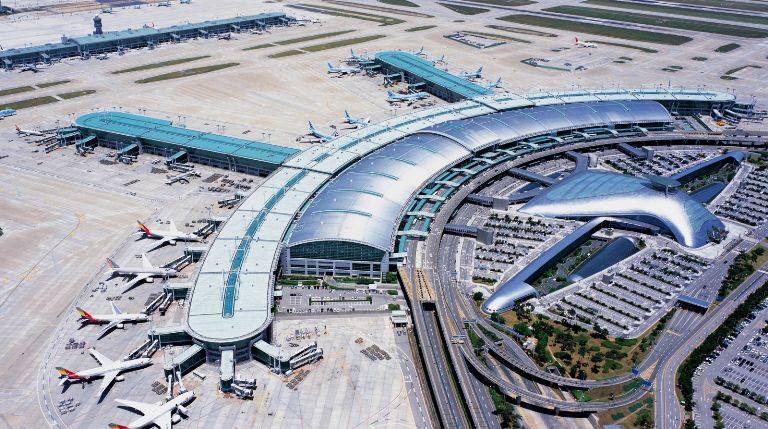
5. Incheon International Airport (ICN)
Precision Planning & Seismic Resilience
Incheon International Airport remains a global leader in operational efficiency and structural resilience.
Seismic Base Isolation System
Terminals incorporate:
-
Lead rubber bearings
-
Energy dissipation dampers
-
Reinforced pile foundations
How It Works:
Ground Motion → Isolation Bearings → Reduced Structural Stress → Preserved Superstructure Integrity
Operational Civil Engineering
-
Underground service tunnels
-
Automated baggage systems
-
Smart passenger flow modeling
-
Prefabricated structural components
Its rapid immigration processing reflects optimized spatial engineering and flow simulation.
Key Engineering Systems Behind the World’s Best Airports
1. Mega-Span Steel Roof Systems
Modern airports utilize:
-
Space frame structures
-
Diagrid systems
-
Ring beams controlling horizontal thrust
-
Pinned connections for thermal expansion
These systems create open terminal spaces exceeding 100-meter spans.
2. Advanced Foundation Systems
Depending on soil conditions, airports use:
Pile Foundations
-
Deep bored piles
-
Reinforced pile caps
-
Load transfer to bedrock
Raft Foundations
-
Large reinforced slabs
-
Soil stabilization techniques
-
Jet grouting and vibro-compaction
Used extensively in reclaimed or soft soil regions.
3. BIM & Digital Twin Technology
2026’s top airports rely on:
-
3D structural modeling
-
4D construction sequencing
-
Clash detection systems
-
Real-time infrastructure monitoring
Digital twins allow predictive maintenance and lifecycle optimization.
4. Passenger Flow Engineering
Design approaches include:
-
Radial terminal layouts
-
Linear concourse systems
-
Computational pedestrian modeling
-
Emergency egress simulations
These systems reduce congestion and improve operational efficiency.
5. Sustainable Construction Materials
Leading airports incorporate:
-
Low-carbon concrete
-
Recycled steel
-
ETFE roofing membranes
-
Photovoltaic glass façades
-
Stormwater harvesting systems
Net-zero terminal strategies are becoming the new global benchmark.
What Makes the Best Airports Architecturally Unique?
The highest-ranked airports in 2026 combine:
✔ Iconic architectural identity
✔ Structural efficiency
✔ Climate-adaptive engineering
✔ Sustainable construction
✔ Seismic and geotechnical resilience
✔ Modular expansion capability
✔ Smart digital infrastructure
They operate as miniature infrastructure cities, integrating transport, environmental systems, and structural design into one cohesive ecosystem.
The Future of Airport Civil Engineering
Looking ahead, airport construction will focus on:
-
Carbon-neutral terminal design
-
AI-driven operational infrastructure
-
Climate-resilient runway systems
-
Prefabricated modular expansion
-
Fully integrated digital twins
The world’s best airports in 2026 prove that aviation infrastructure is now one of the most advanced expressions of civil engineering and architectural innovation.